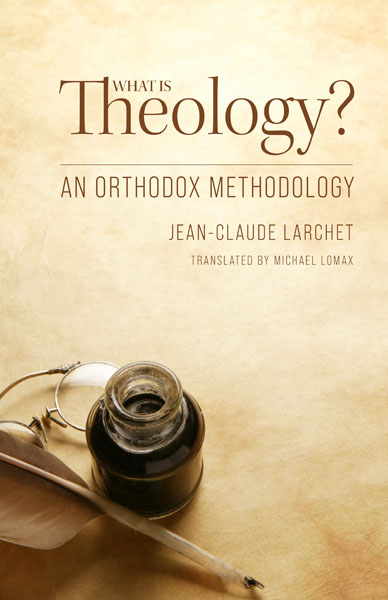
What Is Theology?

An Orthodox Methodology

By Jean-Claude LarchetTranslated by Michael Lomax

$9.99

Please select a format above and click ADD TO CART

Description

Orthodox theology is intimately linked to spiritual
experience. Thus it has a very different meaning to the present usage of
“theology” coming from academia. The scientific methods developed in the West
since the seventeenth century can be of benefit in many regards; however, strong
roots in the Orthodox tradition are needed to avoid the risk of theology being
“eaten up” by the human sciences.


These roots are in the mystical tradition of the Church as passed down
from the beginning and as expressed in the Holy Scripture, the Councils, the
writings of the Fathers, the lives of saints, and its iconography; and as
nourished in the liturgical life of the Church. This tradition “expresses the
faith of the Church beyond time, the permanent faith of the Church, which is
fundamentally the faith in Christ who ‘is the same yesterday, today and forever’
(Hebrews 13, 8).”


The author presents a work that has both a theoretical and a practical
scope, and is of relevance to all Christians.

Additional information

Author Name

Jean-Claude Larchet

Format

ED

Publication Date

20240116

Imprint

Publisher

Translator

Michael Lomax

Language

English

Book Dimensions

0

Format Detail

eBook

Author Biography

Dr Jean-Claude Larchet is one of the most notable
living theologians and authors on Orthodox Christian Patristics. He holds a Ph.D
in philosophy from the University of Nancy and a Ph.D. in theology from the
University of Strasbourg. A teacher of philosophy for nearly thirty-five years,
he is an author of over thirty-five books and countless articles whose work has
been translated into nineteen languages. His magnum opus, Therapy of
Spiritual Illness,
and several other works have been translated into
English to wide acclaim.

Michael Lomax was educated at Cambridge University,
INSEAD Fontainebleau Business School,  and St Sergius Orthodox Academy in Paris.
He entered the Orthodox Church in 1993, which he now serves as a priest. He
lives in Belgium with his wife Irina Gorbunova, a Russian icon painter and art
historian, and works as a translator from French, Dutch, German, and
Russian.

Contents

Foreword

INTRODUCTION

Chapter I. THEOLOGY:  ORIGINAL NATURE, SUBSEQUENT EVOLUTIONS AND
SHAPES

  1. Theology in its most elevated sense: mystical theology
  2. The practice of theology in the Church: catechetical, apologetic and
    doxological theology
  3. The birth and development of speculative theology
  4. The conditions for practicing theology in an Orthodox
    setting
  5. The birth and development of academic theology

Chapter II. THE USEFULNESS OF SCIENTIFIC METHODS IN THEOLOGY

  1. Bibliographic research
  2. The critical editions of texts and their use
  3. Historical criticism
  4. The use of references (precise and exact)
  5. Rational argumentation

Chapter III.  DOGMATIC THEOLOGY 

Chapter IV. SACRED SCRIPTURE AND ITS EXEGESIS

  1. The status of Sacred Scripture in the Orthodox
    tradition
  2. The deleterious character of modern Protestant exegesis and Catholic
    exegesis
  3. Principles of Orthodox exegesis

Chapter V. PATROLOGY

  1. The essential place of patrology in the teaching of Orthodox
    theology
  2. The importance of knowledge of the Fathers in theological knowledge
    and understanding
  3. The need for reference to the Fathers in the practice of
    theology
  4. On the proper use of the Fathers in the practice of
    theology
  5. Thinking in the spirit of the Fathers
  6. The continuing relevance of the Fathers today
  7. Studying the Fathers in their works and not in the commentaries on
    them
  8. Methodology of patristic studies in the field of
    research

 Chapter VI. CHURCH HISTORY

Chapter VII. MORAL THEOLOGY AND BIOETHICS

  1. Moral theology
  2. Bioethics

Chapter  VIII. HAGIOLOGY

Chapter  IX. ICONOLOGY

Chapter  X. STUDY OF THE CANONS

Chapter  XI. PASTORAL THEOLOGY AND HOMILETICS

Conclusion

Notes

Index