Author Biography
Archpriest Seraphim Slobodskoy was born on September 11, 1912, in Cherntsovka, Russia, where his father served as rector of a parish church. Growing up in the Church, Seraphim served as an altar boy, and also became an expert in the art of bell-ringing. His family suffered persecution under Bolshevik rule. Father Alexei, Seraphim’s father, was forced to go into hiding, serving the spiritual needs of his parishioners from the homes of the peasants who housed him. Eventually, Fr Alexei moved to the town of Petushka in the Vladimirskaya province until he was exiled without right of correspondence. He is believed to have died in the gulags, one of the many New Martyrs under the communist regime.
Because his father was a priest and he himself was faithful to the Orthodox Church, Seraphim was denied the privilege of a higher education. Nevertheless, upon graduating from middle school he was allowed to train as a painter. When Nazi Germany invaded the Soviet Union in 1939, he entered the military. Sent to the front, he was captured and sent to a German POW camp, where he spent the rest of the war. While in this POW camp, Seraphim began to dream of building a church, should God preserve him. Although he was supposed to be repatriated to the Soviet Union, he managed to avoid returning to Russia, and ended up living in Munich. There, he met Princess Elena Alexeevna Lopukhina, who became his wife. While in Munich he organized a youth group devoted to discussing religion and philosophy from an Orthodox perspective. The popularity of this group led to Archbishop Benedict (Bobkovsky) of the Russian Orthodox Church Outside of Russia to encourage him to consider ordination. After prayerful thought, Fr Seraphim was ordained by the Archbishop on April 22, 1951.
Shortly after his ordination, Fr Seraphim was sent to the United States to serve as the second priest at Holy Fathers Church in New York City. A short while later he was transferred to Holy Protection Community in Nyack, New York, a suburb of New York City.
It was here that Fr Seraphim was to fulfill his wartime dream of building a church both physically and spiritually. Physically, Fr Seraphim joined his parishioners in working on the construction, including laying cement blocks and hauling wheelbarrows. More importantly, he devoted his time and energy to nurturing the spiritual needs of his parishioners and the community, especially among the youth.
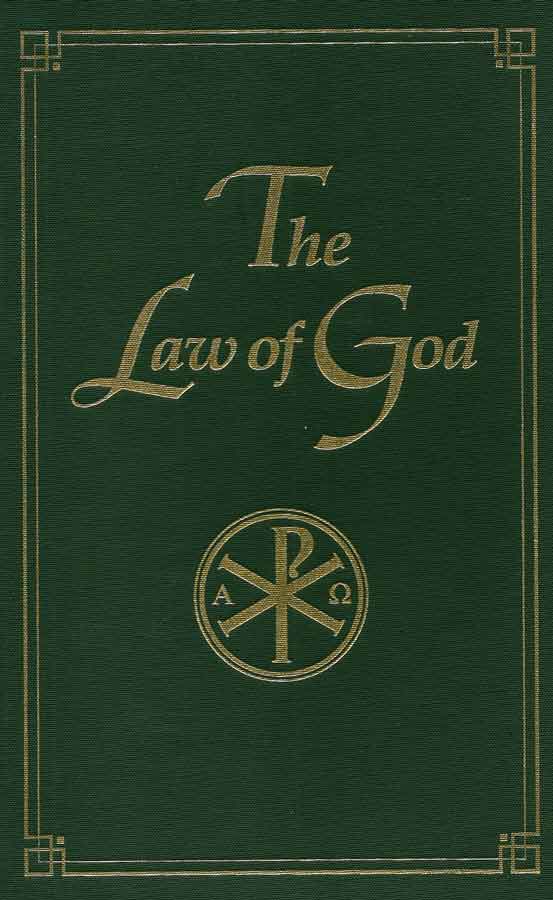
A zealous pastor, Fr Seraphim rarely took a vacation, and when he did, he was not idle, but worked towards educating youth as the spiritual father of Camp NORR (Association of Russian Explorers Outside of Russia). As the parish grew, he and Matushka Elena developed a parochial school to educate the children and youth as Orthodox Christians and Russian-Americans. The most significant of his endeavors, however, was the writing of his catechetical book Zakon Bozhiy (The Law of God). Working late at night, he described the faith of the Orthodox Church with simple and profoundly lucid explanations. Published in 1966, this was, and remains, an influential catechetical text for Russians both abroad and in the Soviet Union, where numerous copies were smuggled in and copied by hand. Intended originally for youth and children, it became a respected work among adults as well, and was finally translated into English in 1992. According to Patriarch Alexei II of Moscow, “the legacy created in the Diaspora was republished in Russia in enormous editions — Archpriest Seraphim Slobodskoy’s Law of God alone, for instance, is used by hundreds of thousands, if not millions, of children in Sunday schools, while teenagers use this book to prepare for seminary.” Many believe that it is one of the finest simple overviews of the Orthodox faith written in modern times.
For his work in producing this book, Fr Seraphim was awarded a gold pectoral cross. Elevated to the rank of archpriest, he also received the kamilavka for his pastoral work, followed by a palitsa for 20 years service as a priest.
Constant exertion in the service of his parishioners undercut the strength of Fr Seraphim, and in 1971, at the age of 59, he reposed.
Contents
TABLE OF CONTENTS
Forward
PART I BASIC CONCEPTS
1. The World
2. About God
3. The Attributes of God
4. Prayer
5. Sin
6. The Sign of the Cross
7 Standing and Bows During Prayer
8. Different Types of Prayer
9. When God Hears Our Prayer
10. Where and How We Can Pray to God
11. The Church Building
12. The Priest’s Blessing
13. Icons
14. Why We call Ourselves Orthodox Christians
PART II PRAYERS
1. Short Prayers
PART III THE SACRED HISTORY OF THE OLD
AND NEW TESTAMENTS
Introduction to the Sacred History of the Old and New Testaments
The Old Testament
1. The Creation of Heaven, the Invisible World
2. The Creation of the Earth, the Visible World
3. How God Created the First People
4. The Life of the First People in Paradise
5. The Fall into Sin
6. The Results of the Fall into Sin and the Promise of a Saviour
7. Discussion of the Fall into Sin
8. Cain and Abel
9. The Flood
10. The Life of Noah and His Children 1
11. The Building of the Tower of Babel and the Scattering of the Peoples
12. The Appearance of Idolatry
13. Abraham
14. The Appearance of God to Abraham in the Form of Three Strangers
15. The Destruction of Sodom and Gomorah
16. The Offering of Isaac as a Sacrifice
17. The Marriage of Isaac
18. Esau and Jacob
19. Jacob’s Vision of the Mystical Ladder
20. Joseph
21. Joseph in Egypt
22. Joseph’s Meeting with His Brothers and the Moving of Jacob into Egypt with His family
23. The Story of Job the Long-Suffering
24. Moses
25. Pascha (Passover) and the Exodus of the Hebrew People from Egypt
26. The Hebrews Pass Through the Red Sea and other Miracles
27. God Gives the Law on Mt. Sinai
28. The Tabernacle
29. The Forty-Year Wandering of the Hebrew People, the Bronze Serpent
30. The Entry of the Israelites into the Promised land
31. Judges
32. The Story of Ruth
33. Saul, First King of the Israelites
34. King David
35. King Solomon
36. The Division of the Israelite Kingdom into Two: Judah and Israel
37. The Prophets
38. The Downfall of the Israelite Kingdom
39. The Fall of the Babylonian Kingdom
40. The Median-Persian Empire. Prophet Daniel in the Lion’s Den
41. The Return of the Jews from Captivity in Babylon and the Construction of the Second Temple
42. The Greek Empire The Translation of the Books f the Old Testament into Greek
43. The Roman Empire. The Universal Expectation of the Messiah
The New Testament
1. The Nativity of the Holy Virgin Mary
2. The Entry into the Temple of the Most-Holy Virgin Mary
3. The Announcement of the Angel about the Birth of the Forerunner
4. The Annunciation to the Holy Virgin Mary
5. The Visit of the Most-Holy Virgin Mary to the Righteous Elizabeth
6. The Nativity of John the Baptist
7. The Nativity of Christ the Saviour
8. The Meeting of the Lord
9. The Flight into Egypt and the Slaying of the Innocents. The Return to Nazareth
10. The Saviour in the Temple as a Youth
11. The Preaching of st. John the Baptist
12. The Baptism of the Lord Jesus Christ
13. The Lord Jesus Christ in the Wilderness and His Temptation by the Devil
14. The Lord Jesus Christ Appears to the People. His First Disciples
15. The First Miracle of Jesus Christ
16. The Merchants are Banished from the Temple
17. The Conversation of Jesus Christ with Nicodemus
18. The Conversation of Jesus Christ with the Woman of Samaria
19. The Healing of the Paralytic at the Pool of Bethesda
20. The Lord Chooses Twelve Apostles
21. The Sermon on the Mount
22. The Power of Faith and Prayer for Others-The Healing of the Paralytic in Capernaum
23. Parables/The Parable of the Sower
24. The Stilling of the Storm
25. Raising of the Daughter of Jarius
26. The Beheading of St. John the Baptist
27. The Miraculous Feeding of the People with Five Loaves
28. Christ Walking on the Water
29. The Healing of the Daughter
of the Canaanite Woman
30. The Confession of Peter. The First Prediction of the Lord about His Forthcoming Suffering,
Death and Resurrection
31. The Transfiguration of the Lord
32. The Parable of the Good Samaritan
33. Jesus Christ with Martha and Mary
34. The Saviour Accuses the Pharisees of Sin-Blasphemy Against the Holy Spirit. Glorification by Christ of the Mother of God
35. Healing of the Man Born Blind
36. The Parable of the Rich Fool
37. The Parable of the Prodigal Son
38. The Raising of Lazarus
39. The Triumphal Entry into Jerusalem
40. The Parable of the Wicked Tenants
41. The Betrayal by Judas
42. The Mystical (Last) Supper
43. The Prayer of Jesus Christ in the Garden of Gethsemane and His Being Taken Captive
44. The Sanhedrin’s Judgement of Jesus Christ
45. The Apostle Peter’s Denial
46. The Trial of Jesus Christ Before Pilate
47. Pilate’s Last Judgement over Jesus Christ
48. The Crucifixion and Death of Jesus Christ
49. The Taking Down from the Cross and Burial of the Saviour
50. The Resurrection of the Lord Jesus Christ
51. The Appearance of the Risen Jesus Christ to Two Disciples on the Road to Emmaus
52. The Appearance of the Lord to All the Apostles and the other Disciples, except
the Apostle Thomas
53. The Appearance of the Lord to the Apostle Thomas and the Other Apostles
54. The Ascension of the Lord
55. The Descent of the Holy Spirit on the Apostles
56. The Life of the First Christians
57. Persecution of the Christians by the Jews-The First Martyr St. Stephen
58. The Dormition of the Mother of God
59. The Apostolic Council in Jerusalem
60. A Short Summary of the Preaching and Lives of the Holy Apostles
61. The Worldwide Persecution of Christians.
The Destruction of Jerusalem
62. The End of Persecution. The Elevation of
the Cross of the Lord
63. New Enemies of Christianity
64. The Ecumenical Councils 4
65. The Fall of the Roman Church.
The Enlightenment of the Slavs 4
PART IV CHRISTIAN FAITH AND LIFE
1. The Purpose of Man
2. Supernatural Divine Revelation. Holy Tradition and Holy Scripture
3. Short Summaries of the Ecumenical Councils
4. The Christian Faith
5. Christian Life
6. The Ten Commandments of God’s Law
7. The Nine Beatitudes
8. Contemporary Teachings and Faith in God
PART V THE DIVINE SERVICES OF THE ORTHODOX
CHURCH
1. The Concept of Serving God, Divine Services
2. The Church Building and its Arrangement
3. The Clergy and Their Sacred Vestments
4. The Order of Divine Services
5. Divine Service Books
6. Reflections on the Major Services.
The Various Liturgies and Their Basic Rubrics
7. The Divine Liturgy
8. The Most Important Actions During the Serving of the Mysteries, and Reflections on Their Significance
9. Great Lent
10. The Sundays of Great Lent, Their Significance and Basic Rubrics
11. The Feast of Pascha, the Radiant Resurrection of Christ
12. Concerning Monasticism and Monasteries
13. Bells and Russian Orthodox Peals