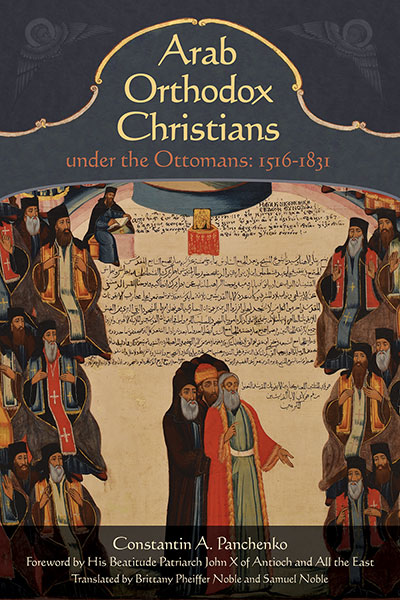
Arab Orthodox Christians Under the Ottomans 1516–1831

By Constantin A. PanchenkoTranslated by Brittany Pheiffer Noble, Samuel NobleForeword by John X (Yazigi)

$19.99

Please select a format above and click ADD TO CART

Description

Over the past two decades, society’s
attention has increasingly returned to the forgotten world of the Christian
East—the whole constellation of bright and now nearly endangered cultures of the
Christian peoples of Southwest Asia and Northeast Africa.

                                                                       
                      -From the Introduction           

Over the past several decades, the world’s attention has been drawn to
the presence of significant minority religious groups within the predominantly
Islamic Middle East. Of these minorities Christians are by far the largest,
comprising over 10% of the population in Syria and as much as 40% in Lebanon.
The largest single group of Christians are the Arabic-speaking Orthodox. This
work fills a gap in the scholarship of wider Christian history and more
specifically that of lived religion within the Ottoman empire. Beginning with a
survey of the Christian community during the first nine hundred years of Muslim
rule, the author traces the evolution of Arab Orthodox Christian society from
its roots in the Hellenistic culture of the Byzantine Empire to a distinctly
Syro-Palestinian identity. There follows a detailed examination of this
multi-faceted community, from the Ottoman conquest of Syria, Palestine and Egypt
in 1516 to the Egyptian invasion of Syria in 1831. The author draws on
archaeological evidence and previously unpublished primary sources uncovered in
Russian archives and Middle Eastern monastic libraries to present a vivid and
compelling account of this vital but little-known spiritual and political
culture, situating it within a complex network of relations reaching throughout
the Mediterranean, the Caucasus and Eastern Europe. The work is made more
accessible to a non-specialist reader by the addition of a glossary, whilst the
scholar will benefit from a detailed bibliography of both primary and secondary
sources. 

“This manuscript fills an important lacuna in the wider
history of the Christian Church as it unfolds the presence and extent of
indigenous Arabic-speaking believers in the Levant…These are matters of great
complexity and a fuller understanding of them will help to shape our
understanding of the takfirism against which we now
struggle.”
    

 – from the Foreword by His Beatitude Patriarch John X of Antioch and
All the East

Additional information

Author Name

Constantin A. Panchenko

Format

ED

Publication Date

20160502

Imprint

Publisher

Translator

Brittany Pheiffer Noble, Samuel Noble

Language

English

Book Dimensions

0

Format Detail

eBook

Foreword

John X (Yazigi)

Author Biography

Constantin A. Panchenko (1968-2024) was an Associate
Professor in the Department of Middle and Near East History (Institute of Asian
and African Studies) at the Lomonosov Moscow State University. He authored about
100 academic publications, including two monographs, collections of essays,
articles and abstracts on the history of the Middle East. His major sphere of
interest was the history of the Christian Arabs, particularly the Middle Eastern
Greek Orthodox community in the Middle Ages and Early Modern period.

Brittany Pheiffer Noble holds an M.A. in Religion from Yale University
School of Divinity and a doctorate in Russian Literature from Columbia
University, New York. She is the co-translator with Samuel Noble 
of Arab Orthodox under the Ottomans:1518-1831, Constantin
Panchenko. Jordanville, NY: Holy Trinity
Seminary Press, May, 2016. She lives in Leuven, Belgium. 

Samuel Noble is a doctoral researcher at the Faculty of Theology and
Religion Studies at the Louvain Centre for Eastern and Oriental Christianity at
KU, Leuven in Belgium. He is the co-editor of The Orthodox Church in
the Arab World: An Anthology of Sources, 700-1700
(Northern Illinois
University Press,2014) and co-translator of Arab Orthodox Christians
under the Ottomans: 1516-1831
. (Holy Trinity Seminary
Press,2016)

Contents

Foreword

Introduction

1. The Historical Context: Orthodox Christians

Under Muslim Rule from the Sixth to the Fifteenth Century
1

2. The Political Background

3. Geography and Demographics

4. Shepherds and Flock

5. Monks and Monasteries

6. The State Within the State

7. The Holy Sites

8. Foreign Affairs

9. The Catholic Unia

10. The Culture of the Orthodox Orient

Conclusion

Appendix: Patriarchs and the Sultans

Notes

Glossary

Bibliography

Acknowlegments

Index of Names

Geographical Index

Maps

illustrations