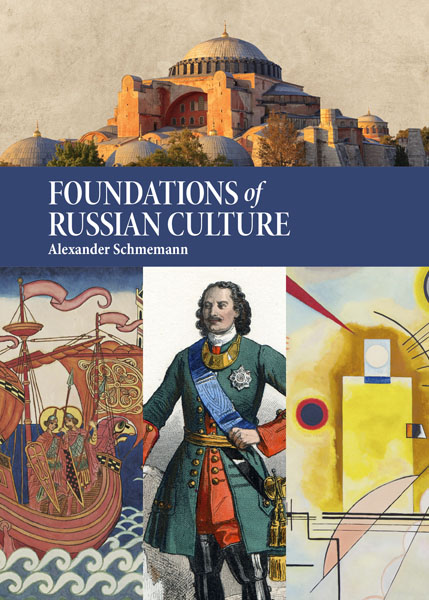
Foundations of Russian Culture

By Alexander SchmemannTranslated by Nathan K. WilliamsForeword by Serge Schmemann

$35.00

40 in stock

Please select a format above and click ADD TO CART

Description

A culture that demands only freedom from politics, while rejecting
and shunning politics itself, remains inadequate, lifeless, and is ultimately
doomed. In its turn, politics that rejects the spiritual oversight of culture
inevitably degenerates into tyranny or anarchy, into corruption and
mediocrity.

Inside this deceptively
modest volume will be found a remarkably prescient collection of broadcasts,
that are perhaps even more pertinent to the contemporary culture and politics of
Russia than they were to the audience within the Soviet Union to whom they were
originally addressed.  Schmemann presents the complex history of Russia and
analyzes trends and tendencies within its culture concisely and simply: showing
them to be frequently contradictory and even mutually exclusive. He clarifies
the multilayered meaning of “foundations”—its  underlying building blocks, the
spiritual, the political, the historical, as well as the cultural assets in
literature, art, science, and philosophy. In these elements he shows what Russia
is grappling with in its struggle to find a synthesis that draws both from its
own unique elements and its historical and ongoing interconnectedness with the
“West” and the “East.”



Additional information

Dimensions 127 × 178 in
Author Name

Alexander Schmemann

Format

BB

Publication Date

20240206

Imprint

Pages

312

Publisher

Translator

Nathan K. Williams

Language

English

Book Dimensions

178 × 127 mm

Format Detail

Limited Edition

Foreword

Serge Schmemann

Author Biography

Protopresbyter Alexander
Schmemann
(1921-1983) was born in Estonia, raised and educated in
France. He spent most of his working life in the United States as an Orthodox
priest, educator, author and radio broadcaster, serving as Dean of St Vladimir’s
Seminary in Yonkers, New York from 1962 until his death in 1983. Many of his
books remain in print both in English, Russian and other languages.

The Rev. Nathan K. Williams is a
professional translator. He studied Russian at Holy Trinity Seminary
(Jordanville, NY), where he earned a bachelor’s degree in Theology, and went on
to receive a master’s degree in Russian from Middlebury College,Vermont. In
addition to his work as a translator he serves as an Orthodox priest at St.
Alexander Nevsky Church in Gardiner, Maine.
 
Serge Schmemann is an award winning
journalist, writer and broadcaster. He won the Pulitzer Prize in 1991 for
coverage of the reunification of Germany and an Emmy in 2003 for his work on a
television documentary about the Israeli-Palestinian conflict. He was the deputy
foreign editor of the New York Times from 1999 to 2001, having previously served
as a Times correspondent and bureau chief in Moscow, Bonn and Jerusalem and at
the United Nations. From 2003 to 2013 he worked as editorial page editor of The
International Herald Tribune in Paris from 2003 to 2013. A graduate of Harvard
College he holds an M.A. from Columbia University. He has authored two books and
is a member of the editorial board of the New York Times. He lives in
Washington, DC.

Contents

Foreword

Introduction

Note to the Reader

  1. The Cultural Debate in the USSR: A Protest
  2. The Dispute Over Culture in the Soviet Union
  3. “Culture” in Russian Self-Identity
  4. Paradoxes of Russian Cultural Development: Maximalism
  5. Paradoxes of Russian Cultural Development: Minimalism
  6. Paradoxes of Russian Cultural Development: Utopianism
  7. The “Explosion” of Russian Cultural Identity in the Nineteenth Century
    (1)
  8. The “Explosion” of Russian Cultural Identity in the Nineteenth Century
    (2)
  9. The “Explosion” of Russian Cultural Identity in the Nineteenth Century
    (3)
  10. Renunciation of Culture in the Name of Pragmatism
  11. Renunciation of Culture in the Name of Religion
  12. Renunciation of Culture in the Name of Social Utopia
  13. Tolstoy and Culture
  14. Dostoevsky and Russian Culture
  15. Cultural Identity at “the Beginning of the Century”
    (1)
  16. Cultural Identity at “the Beginning of the Century”
    (2)
  17. Abandonment of the Moral Foundations of Culture
  18. The Initial Reaction to the Revolution
  19. The Enslavement of Culture
  20. Creative Resistance (1)
  21. Creative Resistance (2)
  22. Creative Resistance (3)
  23. The Past and Tradition
  24. The West
  25. Technology and Science
  26. Social Topics
  27. Religious Themes
  28. At A Crossroads
  29. On the Path to Synthesis (1)
  30. On the Path to Synthesis (2)
  31. Conclusion

Acknowledgments

Notes

Index of Names