

Additional information
| Dimensions | 140 × 216 in |
|---|---|
| Author Name | Pavlos M. Kyprianou |
| Format | BC |
| Publication Date | 20230808 |
| Imprint | |
| Pages | 168 |
| Publisher | |
| Language | English |
| Book Dimensions | 216 × 140 mm |
| Format Detail | Paperback |
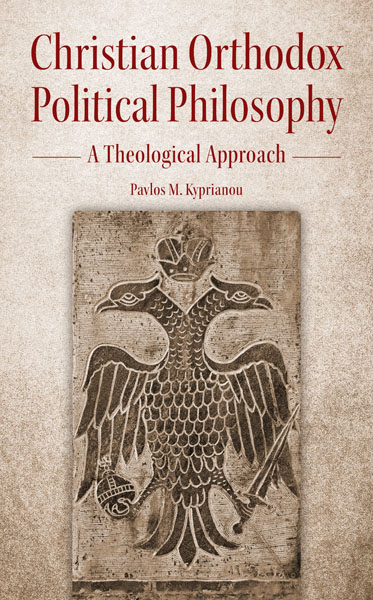
$24.95
56 in stock
The
Church is commonly spoken of as an institutional reality, and is
much less frequently recognized as a spiritual and heavenly reality called by
God “to make disciples of all nations” (Matt 28:19).
This structured and integrated work presents a Christian Orthodox
political thought in which the Church is neither sidelined as having no
relevance to this present life, nor dominated by temporal questions or popular
movements at the expense of its eternal salvific mission.
The author grounds the mission of the Church in the present world both
on an understanding of God as Trinity and in her mission to baptize diverse
cultures. To do this effectively the Church must recognize and adapt to local
and contemporary political and social trends and patterns. It must exemplify the
Gospel as a way of communal and social life, not allowing itself to be reduced
to an impersonal ideology manifest within the sphere of imagination, ideology,
or a private individualistic existence.
Drawing upon this philosophy, the author proposes a way for the Church
to understand questions of both domestic politics and international relations
with a view to bringing the world into the Kingdom of God. He suggests specific
steps that could be taken to heal and strengthen inter-Orthodox relations,
addressing in particular the canonical challenges of the Orthodox diaspora and
tensions between the Greek and Slavic components of the Church. Though these
specific proposals will by no means enjoy universal acceptance, they will serve
as a springboard for further dialogue as the Orthodox world seeks to apply these
principles in all nations, no matter their current political
circumstances.
| Dimensions | 140 × 216 in |
|---|---|
| Author Name | Pavlos M. Kyprianou |
| Format | BC |
| Publication Date | 20230808 |
| Imprint | |
| Pages | 168 |
| Publisher | |
| Language | English |
| Book Dimensions | 216 × 140 mm |
| Format Detail | Paperback |
Foreword
Preface
INTRODUCTION
—The inspiration behind this book
—Aims of the Book
—Outline of the Book
—Brief History of the Church
—The Church is the pre-fall world
—The fallen world is the same as the pre-fall world only now under
demonic influence
—The relationship between the Church and the world after the
fall
—Churchly sanctification of the world v worldly secularization of the
Church
—The nation as a post-fall phenomenon
—Nationalism as a post-fall ideology
—Ideology as division and heresy
—Sanctification and self-transcendence of the nation
—The Mission of the Jewish Nation to the World
—How Christ viewed his own nation
—The fall out of Christ with the national establishment
—How the Apostle Paul viewed his own nation
—The national self-transcendence of the Greek nation for the sake of a
Christian World
—Christian Orthodoxy vis-a-vis national power, resistance and
liberation
—Conclusion: cohabitation, adoption and ecumenization of the nation by
the Church within the Church, and through the Church
—The state as a post-fall phenomenon
—The recognition of the role of the state by the Church
— Relationship of the Church with political power
—A person-centered system of government – Monarchy
—The relationship of the Church with ideologies and
parties
—Church and human rights
—Church and Person-centered Economic Policy
—A Person-centered Legislative System
—A Person-centered Judicial System
—Priority of local state-national consciousness over ‘supra-state’
national consciousness
—Coexistence of Local and Universal (Ecumenical) Awareness
—Church and national symbols
—Preference and support of the Church for the creation and/or
strengthening of multinational Orthodox-majority states
— ‘Covariation’ with a constructive and not negating effect
— Conclusion
—Definition
—Diaspora and ecclesiastical disorder
—The principle of ‘covariation’ and the Orthodox Diaspora
—The Geopolitical division between Orthodox states
—Russia ‘Protector of Orthodox Peoples’
—The granting of autocephaly to a local Church
—Transcending the diarchy between the Greek and Russian world
—World unity in Christ
—Adaptation of the Church to political and state conditions in order to
reinforce its spiritual work and influence
—The institutionalized protection and implementation of human rights
within a person-centered and commune-centered context
—The Church should encourage the combined implementation of ideologies
to strengthen the state and serve society
—The Church – institutionalized and official Advisor to the state but
without institutionalized power
—The Church should encourage citizens, politicians and political
parties to resist and refrain from identifying with ideologies
—The Church in support of the institution of Monarchy within a
democratic framework. 110
—The Church in support of a centrist, person-centered economic
policy
—Establishment of advisory bodies with eligibility for membership to
those who contribute to the state treasury over and above their tax
obligations
—The creative ‘covariation’ of the Church with state
administrations
—The creation of multinational states or commonwealths, and the
creation of a common national awareness based on Orthodox civilization
—The Orthodox Diaspora should become a field of healthy missionary
competition and transcendence of nationalism
—Official recognition of the Russian Federation as the Geopolitical
Protector of Orthodoxy
Bibliography
Appendix: The war in Ukraine
Notes
Bibliography
Index
Jean-Claude Larchet
Holy Trinity Monastery
Anastasy (Gribanovsky)
Michael Pomazansky
