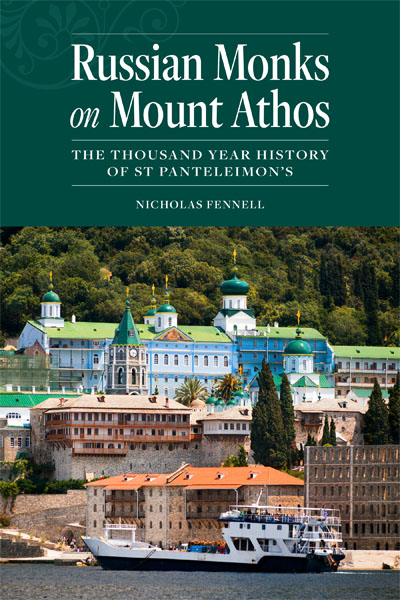
Russian Monks on Mount Athos

The Thousand Year History of St Panteleimon's

By Nicholas Fennell

$38.95

44 in stock

Please select a format above and click ADD TO CART

Description

The Holy Mountain of Athos is a self-governing
monastic republic on a peninsula in Northern Greece. Standing on the shores of
the Aegean Sea is one of the twenty ruling monasteries that comprise the
republic, that of St Panteleimon, known in Greek as the Rossikon. Its building,
fully restored in recent years, can accommodate up to 5,000 men, reflecting the
scale of the settlement at its apogee in the nineteenth century and prior to the
Bolshevik revolution in Russia. Since the fall of the Soviet Union in 1991 the
monastery has experienced a strong revival and is now among the most numerous of
the twenty. But the vast buildings that can be seen today are a reflection of
only the past two centuries. That the Russian presence on Athos goes back more
than one thousand years is much less well known.

This book is the first comprehensive account in the English language of
this millennium of history. The author has been able to draw from previously
inaccessible archival materials in gathering the wealth of information he shares
in this work. The history of the community is not described in geographical
isolation but shown as interacting with the much wider worlds of the Byzantine
and Ottoman empires and the modern nation state of Greece, together with that of
the Russian homeland whose political character is constantly evolving. There are
shown to be three distinct phases in this history: 

  • from the tenth to the twelfth centuries when Russian Athonites
    inhabited the ancient Russian Lavra of the Mother of God, also known as
    Xylourgou;
  • then the six hundred years from the mid-twelfth to the mid-eighteenth
    century when the ancient Monastery of St Panteleimon was the Russian house on
    Athos, more commonly referred to as Nagorny or
    Stary Rusik;
  • the most recent 250 years, that are naturally covered in greater depth
    thanks to the wider availability of sources.

Amongst the themes explored in the book are ethnic relations, the
Pan-Orthodox ideal, the role of money and political pressure, sanctity and
heroism in adversity, and the importance of historical memory and precedent. The
author seeks to arbitrate fairly between often strongly opposing ethnic
viewpoints. 

It examines in detail the fluctuating fortunes of the monastic
community of St Panteleimon during the past 250 years, when its ethnic identity
was frequently questioned. St Panteleimon’s is a history that has been blighted
by Greek-Russian quarrels, mass deportation of dissenting brethren, troubles in
the Caucasus, and even tangential implication in the present-day dispute between
the Ecumenical and Moscow Patriarchates over Ukraine.

This text will be invaluable to both academic historians and the
general educated reader who does not possess specialist knowledge. It is
complemented by a timeline, glossary, comprehensive bibliography, index,
full-color illustrations and photographs.

Additional information

Weight 1 g
Dimensions 153 × 229 in
Author Name

Nicholas Fennell

Format

BC

Publication Date

20210928

Imprint

Pages

280

Publisher

Language

English

Book Dimensions

229 × 153 mm × 2 mm

Format Detail

Paperback

Author Biography

Nicholas Fennell holds a MA in Modern and Mediaeval
Languages from Trinity College Cambridge, where he was a Senior Scholar, and a
PhD from Southampton University. He is a member of the Friends of Mount Athos
and of the Institute of the Athonite Legacy in Ukraine. The author of three
previous books on Athonite Russian history, he has been researching and visiting
Mount Athos since the 1980s.

Contents

Introduction: The Russian Monastery on Mount
Athos

1 – The Monastery’s Early History: from Xylourgou to the Old Mountain
Rusik

2 – From Abbot Savvas to Abbot Gerasim

3 – The Return of the Russians in the Reign of Abbot
Gerasimos

4 – The New Spiritual Father and Leader of the Russian Brotherhood is
Chosen

5 – The Crimean War

6 – The Greek and Russian Brotherhoods at Loggerheads

7 – The Reign of Archimandrite Makary

8 – Makary’s Successors: Abbots Andrey and Nifont 1889–1905

9 – Archimandrite Misail

10- The Name of God Dispute

11 – From 1913 to Abbot Misail’s Death in 1940

12- The Next Four Abbots: from Iustin to Avel´ (1940–1978)

13 – From Abbot Ieremiya to Abbot Evlogy

 Conclusion

Timeline

Acknowledgements

Notes

Glossary

Bibliography

Index